
562
Item nr.
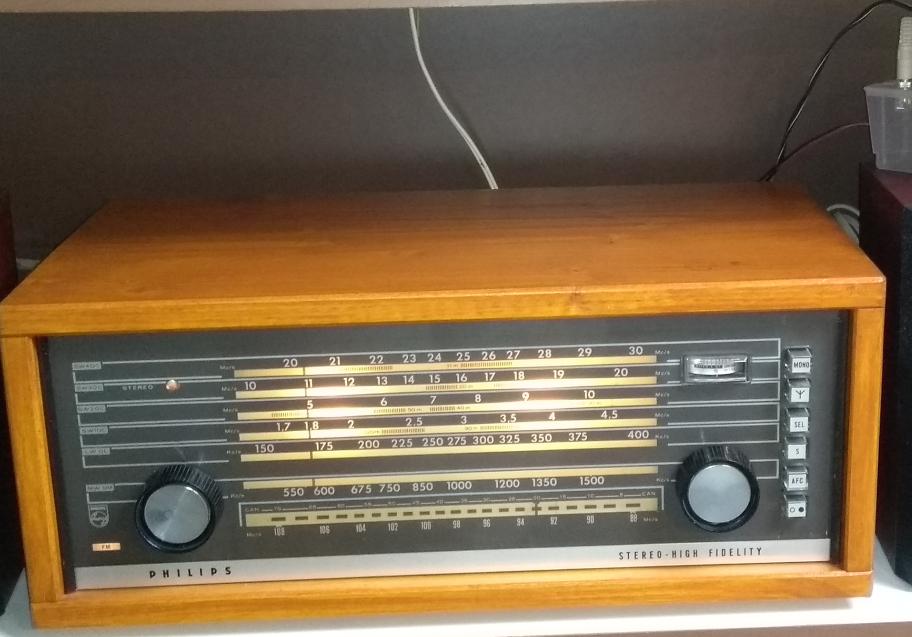
| Production | The Netherlands, 1963. |
|---|---|
| Bands | LW, MW, 4xSW (1.6-4.6, 4.5-10.6, 10.5-20.1, 19.8-30MHz), FM (88-108MHz), MF is 452kHz and 10.7MHz. |
| Semi- conductors | 22 Transistors, 21 diodes. |
| Cabinet | Wood (non original). Size 47.5x19x25cm. |
| Power | AC 6W. |
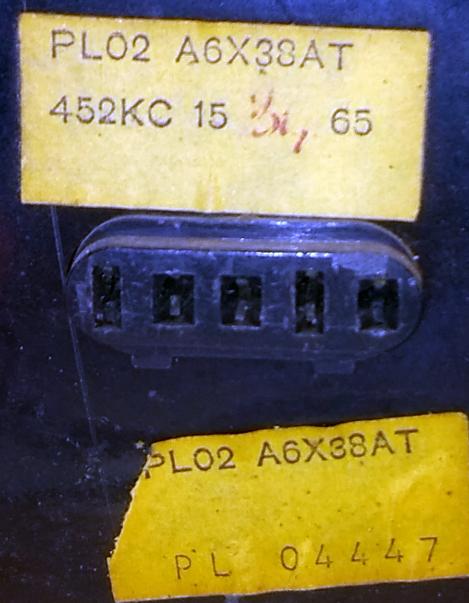 pictures of the Philips A6X38AT tuner show station names on the BC dial, but this tuner, though of the same type, has none. The dial shows a code (under the tuning knob) ending in OV, so probably this is the OVerseas dial. There is no execution suffix indicating that this model differs from the continental version.
 The Philips A6X38AT is praised as one of the best tuners made by Philips, and there is reason for this. With three IF stages for AM, and four even for FM, sensitivty and selectivity are very good. The AM front end is a bit unusual for Philips. Most Philips sets feature a single transistor as self-oscillating mixer, but here we see an RF amp, and seperate oscillator and mixer, so three transistors in the front end. There is also an amplified AGC and an S-meter. Then, there are two circuits one almost never finds in AM radio's: AFC and Squelch (Silent tuning). The AFC corrects imprecise tuning, and the Squelch suppresses noise and crackles between stations (and hides weak stations! But fortunately it can be switched off). Tuning the SW bands with both features in effect almost makes the tuning knob feel like a preselector switch: one moves from one SW station to the next, without intermittent noise, and all stations are perfectly tuned and sound very high quality.
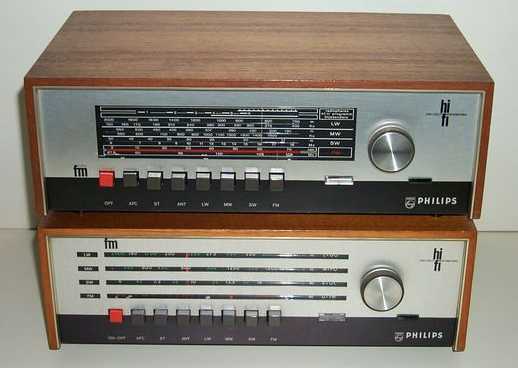 Around 1966, the tuner was succeeded by the 22GH924 (photo right), also available with "European" and "OVerseas" dial.
| Obtained | 4/2022 from Jan Schattorie at NVHR market; sn=PL04447. |
|---|---|
| Condition | 7; cabinet replaced, no back panel. |
| Disposed | Sold 3/2023. |
The FM worked, but AM was defective. 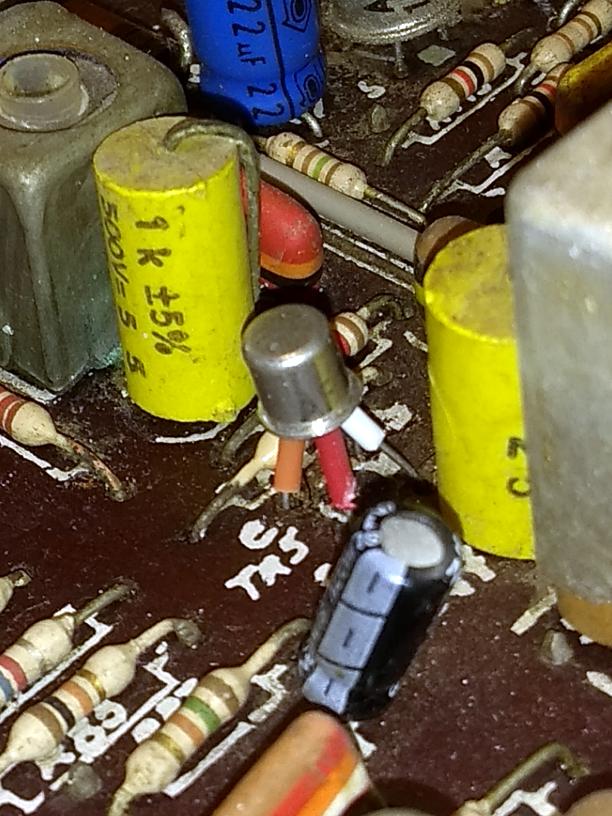 Inserting a 452kHz signal on the Basis of T8 (first IF) produced sound in the speaker, and so did a signal on the Collector of T5 (mixer). But signal on the Basis of T5 gave nothing, which led to suspicion of T5. DC measurements showed 0.0V on the Emitter, -2.3 on the Basis and -10 on the Collector, while a functioning transistor in this position would draw Emitter current and have a -2.0V over the Emitter resistor R15 (of 2k2). I concluded that T5 (AF124) was defective. Fortunately, a couple of years ago I repaired a Philips L3X02T, for which I bought six AF139, and two were still there. I soldered half of my Germanium transistor stock in the tuner, and then it worked.
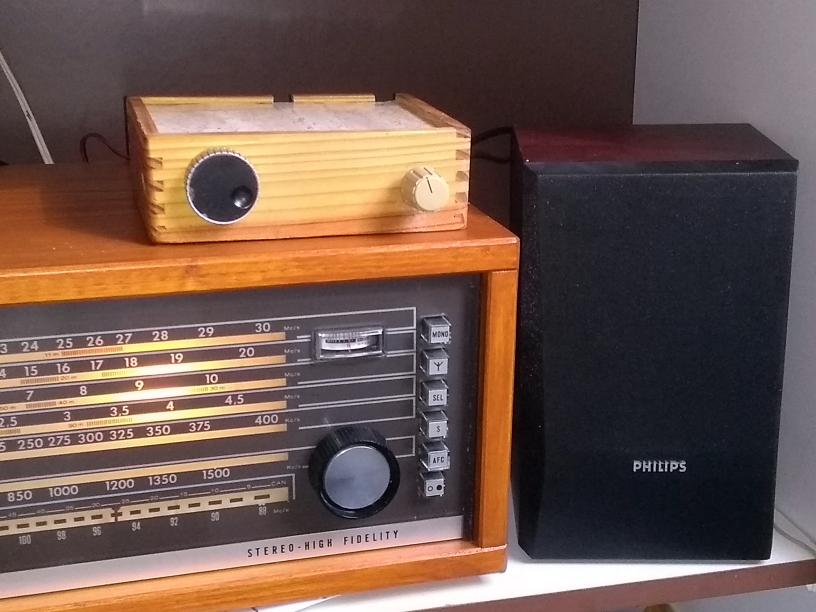 A ride to the Thrift store gave me nice Philips speakers and at the moment I connected it with a mini amplifier.
 The SW4 band plays the wrong frequencies. It is supposed to tune 20 to 30 MHz, but on my set I hear stations in the 20m band in the SW4 position. As there are hardly any broadcast stations above 20MHz, this is not a big deal, but still it would be nicer to have the right frequencies.
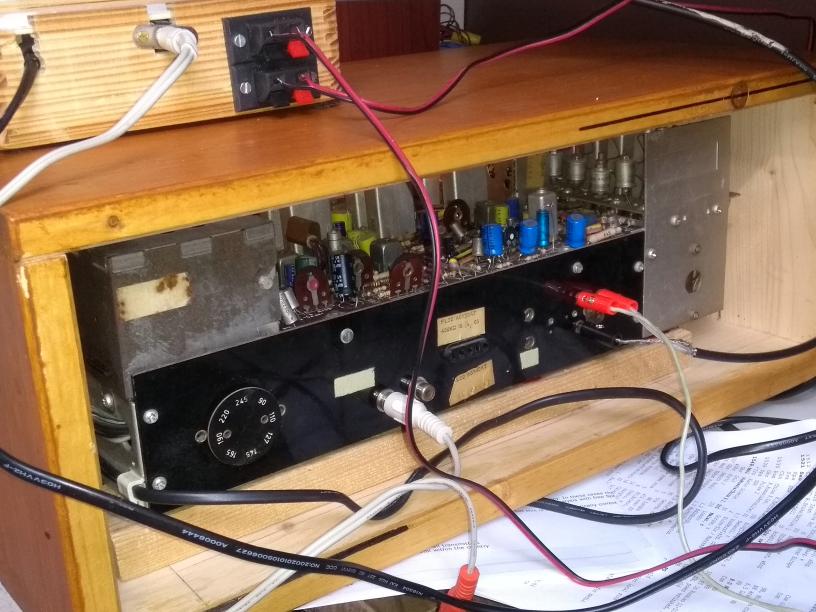
The tuner lacks the back panel. While it is normally fitted with a five prone IEC plug, here there is an additional pair of tulip jacks. So all in all, the back side of my set looks as shown on the right.